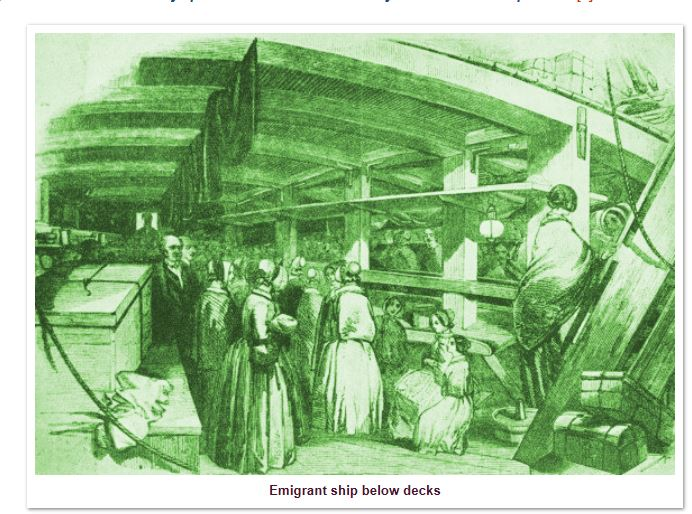
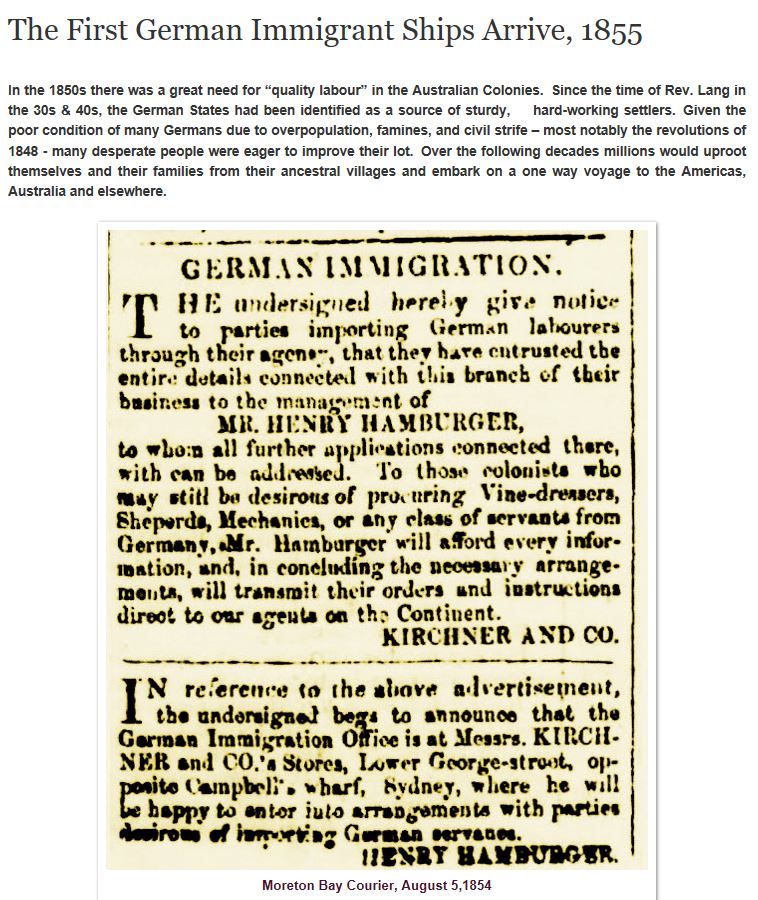
In the early 1830s, the fertile valleys of the Hunter River¹ became a quiet refuge for German emigrants seeking a new beginning. Among the first arrivals were families such as the Schmidts², Brauns³, Müllers⁴, and Hoffmanns⁵, who, leaving behind the uncertainties of Prussia⁶ and Saxony⁷, voyaged across oceans with little more than hope, faith, and the skills honed over generations.
Settling in the districts of Maitland⁸, Paterson⁹, and nearby valleys, the Germans found a land both promising and unforgiving. The rich alluvial soils lent themselves to wheat and maize, while the slopes of the hills proved ideal for the vineyards some families planted, bringing with them knowledge of European viticulture. Johann Schmidt², for instance, is recorded in the 1840s as cultivating grapes along the Hunter River¹, introducing techniques that would influence local winemaking for decades.
Community was central to life. The Brauns³, living on the outskirts of Paterson⁹, helped establish one of the earliest Lutheran congregations¹⁰ in the valley. Their church became more than a place of worship; it was a school, a meeting hall, and a sanctuary where the German language, songs, and traditions were preserved. Children learned reading and arithmetic alongside hymns in their native tongue, creating a bridge between old and new worlds.
Daily life was laborious. Families rose with the sun to tend fields, repair homes, and maintain the orchards and vineyards they had planted. Winter floods or scorching summers could destroy crops, yet resilience was ingrained. Correspondence with relatives in Europe⁶,⁷, along with visits from itinerant traders, maintained a link to their homeland and provided guidance on the challenges of colonial life.
Over time, integration into the broader colonial society occurred. Intermarriage with Irish and British settlers became common, though the German heritage remained strong. During periods of conflict, particularly World War I¹¹, some families faced suspicion, and surnames were sometimes Anglicized to avoid prejudice. Yet the legacy endured. Vineyards flourished, farmhouses built with German craftsmanship still dotted the countryside, and festivals and customs subtly influenced the culture of the Hunter Valley¹².
Even today, the descendants of these early German settlers carry their traditions quietly forward. In towns like Maitland⁸ and Paterson⁹, the imprint of their ancestors remains in family names, church records, and the enduring appreciation of the land they transformed. Their story is one of courage and perseverance—a testament to the enduring spirit of those who left everything familiar behind to plant roots in a distant valley, turning it into home.