
Norman Laurence Brown and the Rothbury Colliery Riot, 1929: A Tragic Chapter in Australian Labor History
On Monday, 16 December 1929, Norman Laurence Brown was wounded during a violent confrontation at Rothbury Colliery, New South Wales, and later died at Maitland Hospital. His death became one of the most tragic and defining moments in the bitter coal miners’ strike that year—a conflict marked by intense class struggle, police violence, and the fight against the introduction of free labor.
The Rothbury Riot: A Day of Turmoil
Approximately five thousand miners had gathered at the gates of Rothbury Colliery to protest the mining company’s introduction of free labor—workers not bound by union agreements, which threatened to undermine the miners’ hard-won rights and solidarity. The demonstration quickly escalated into rioting, and police opened fire to control the crowd.
Newspaper headlines from the Cessnock Eagle and South Maitland Recorder the following day screamed:
Sensational happenings at Rothbury Colliery.
FIVE THOUSAND MINERS ASSEMBLE AT COLLIERY GATES.
RIOTING, SHOOTING, AND LOSS OF LIFE.
DEMONSTRATION AGAINST INTRODUCTION OF FREE LABOUR.
(Cessnock Eagle and South Maitland Recorder, 17 Dec. 1929)
Tragically, one miner—Norman Laurence Brown—was killed, and three others were critically wounded.
The Inquest and Official Findings
Following a six-day inquest, the Maitland District Coroner, Mr. D.W. Reed, determined that Brown died from the effects of a gunshot wound accidentally received during police efforts to quell the riot. Crucially, the coroner found that Brown was not involved in the rioting at the time of his injury. The police were exonerated, with the conclusion that they exercised all ordinary skill and caution to avoid unnecessary harm (Cessnock Eagle and South Maitland Recorder, 18 Feb. 1930).
Despite the official verdict, the events at Rothbury remain a stark reminder of the perilous conditions and violence miners faced during this tumultuous period.
Remembering Norman Laurence Brown
Norman was not born into the mining community but arrived from Annandale in 1900. His birth and death certificates list his mother as Laura E. Brown, with no record of his father’s name (Birth Certificate, 1900; Death Certificate, 1930). His stepfather, Albert George Kidd, testified at the inquest, though no marriage record has been found (Hooker, cited in Randall, c.1993). Norman was described by those who knew him as a quiet, unassuming young man, an active sportsman, and a member of both the Freemasons and the G.U.O.O.F. (Maitland Daily Mercury, 18 Dec. 1929).
On the day of his death, Norman carried approximately fourteen pounds—a significant amount given the modest eight shillings strike pay for a single man. It was suggested that he had won this money playing cards shortly before the riot (Maitland Daily Mercury, 10 Feb. 1930).
His funeral at Greta Cemetery drew an estimated crowd of 7,000 mourners, reflecting the community’s deep respect and grief. The Bishop of Newcastle and local dignitaries delivered eulogies, honoring Norman’s character and lamenting the loss of such a promising young life.
Alderman Gordon of Cessnock Municipal Council summarized the sentiment shared by many:
“It is a matter for profound regret that such a boy as this should lose his life. Norman Brown, whom I knew personally, was one of the quietest and best boys who lived about Greta. He was really a fine boy, and one that we could ill afford to lose” (Cessnock Eagle and South Maitland Recorder, 20 Dec. 1929).
The Broader Context: Class Struggle and Labor Rights
The Rothbury Riot was emblematic of the fierce struggles between mining unions and companies during the late 1920s and early 1930s in Australia. The introduction of free labor threatened union cohesion, leading to widespread strikes and lockouts. The resulting confrontations often involved police and private security forces, escalating to violence and loss of life (Ross, 1984; Jay, 1994).
The event remains a poignant reminder of the sacrifices made by miners like Norman Brown, whose deaths underscored the brutal realities of industrial conflict. His story is preserved in union histories, newspaper archives, and commemorations by descendants of those who lived through the era.
Norman Laurence Brown.
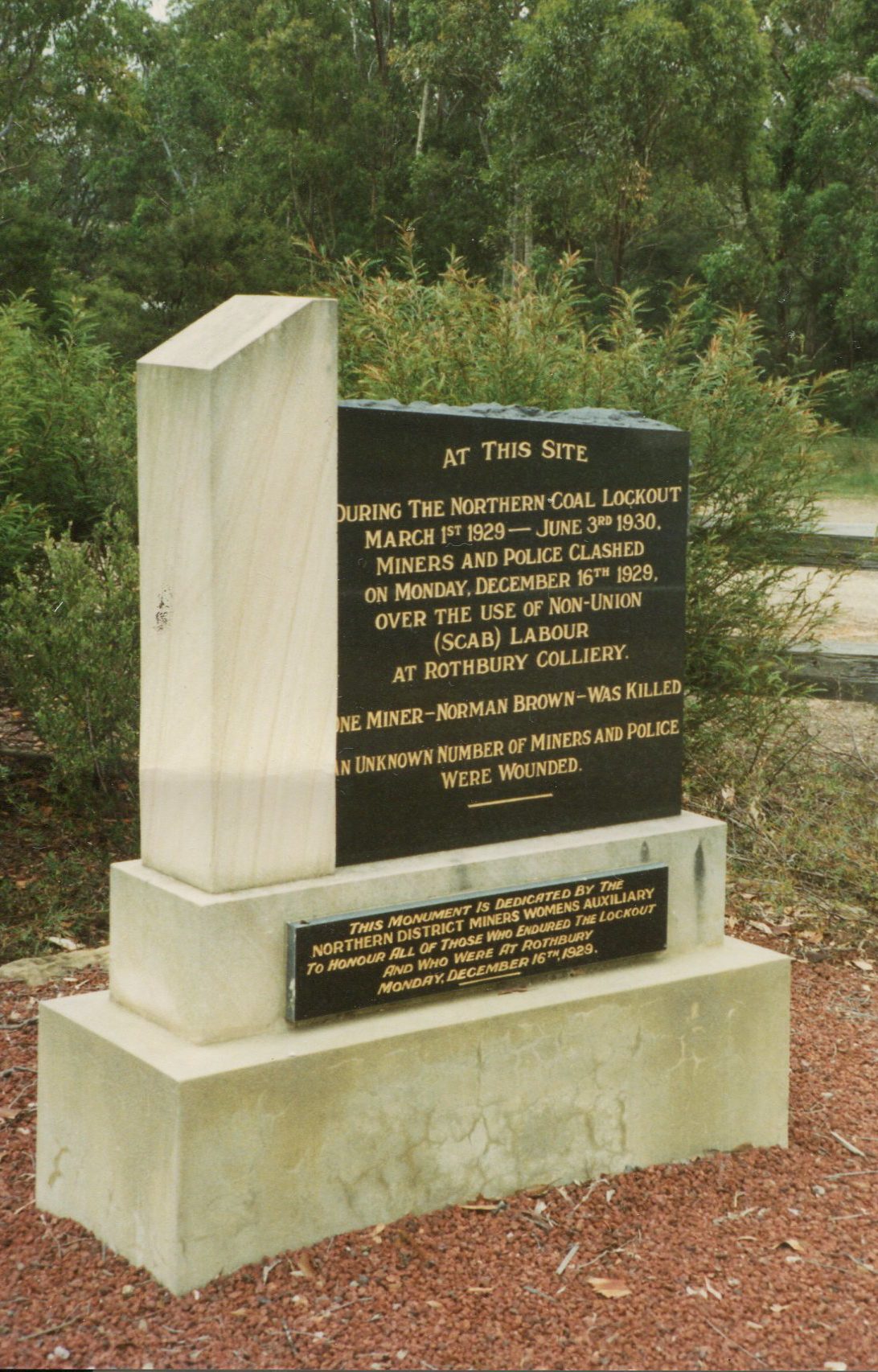
Maitland District Coroner, Mr. D.W. Reed, found that ‘Norman Laurence Brown… died from the effects of a gun shot wound accidentally received at Rothbury … during the course of a quelling of a riot by police officers… the said Norman Laurence Brown not then being one of the rioters’. Mr. Reed then went onto exonerate the police by finding that ‘they (the police) exercised all ordinary skill and caution so as to do no more harm then could be reasonably be avoided’.[1]
Brown was buried in the Greta cemetery before a crowd of 7,000. The Maitland Mercury of the 18 December 1929 gives a full report of the Bishop of Newcastle eulogy as well as those of other notables present. The comments of the minister who was at the service on the size of the funeral and the emotions are recorded some 50 years later at the unveiling of the 50th anniversary tablet. [2]
The details of the events of the day are well documented in the references given albeit that there are differing opinions and statements as to the actions of the police and miners.
Not so much for the enigmatic Norman Laurence Brown. Norman was not born on the coalfields but at Annadale in 1900. Neither his death nor birth certificate record the name of his father.[3] At the inquest into his death Albert George Kidd gave evidence that he was his stepfather. However I cannot find any record of a marriage of a Albert Kidd and Laura Brown in N.S.W up to 1945 which does not necessarily mean that there was none. In any case Jim Hooker recollects Norman parents, Mr. and Mrs. Albert Kidd of Lewis Street and a daughter Grace.[4]
His birth certificate and his death certificate both records his mother name as Laura E Brown.[5] Whilst these records spell his second name as ‘Lawerence’ and the corner inquest also refers to ‘Lawerence’ some of the newspaper reports and his tombstone inscription spells it as ‘Laurence’. This latter information would have been most likely been supplied by his mother and given that her first name and the first letter of her second names are the first letters in Norman’s name it could be argued that the latter is correct. [6] One could infer from that that the boy’s second name came not from the customary paternal side but from his mother which is supported by the absence of a father’s name on the birth and death certificates.
The eulogies at the funeral service described him as ‘of a very quiet, unassuming disposition’, an active sportsman’s and a member of the Freemasons and the G.U.O.O.F[7]
Alderman Gordon of the Cessnock Municipal Council in moving that a letter of sympathy be sent to his parents said :
It is a matter for profound regret that such
a boy as this should lose his life. Norman Brown,
whom I knew personally was one of the quietest and
best boys who lived about Greta. He was really
a fine boy, and one that we could ill afford to lose[8].
The inquest reveals that at the time of his death he had in his possession ‘about fourteen pounds’ [9] ; a significant amount for those days particularly as Norman was not married and the strike pay for a single man was only eight shillings.[10] The locked out miners were encouraged to be at Rothbury that day by promises and threats. The promise of double strike pay for Xmas payable that day but only payable personally at the pit.[11] And threats that if they did not turn out they would be ‘dealt with’.[12]
However the double strike pay would not explain the large sum unless he had as his step father Albert Kidd said at the inquest ‘(Norman )… was only going to have a game of cards in the bush’ and he had had a significant win.[13] Unfortunately he was not to live to spend it.
References:
Crowley, F. [ed.] A New History of Australia, Heinemann, Melbourne, 1980.
Jay. C., The Coal Masters. The History of Coal and Allied 1884-1944, Focus
Publishing, Double Bay, 1994.
The reference cites the unpublished memoirs of Althol Lightfoot, a former mine
manager who gives a slightly different perspective on the riot.
Northern District Miners Women’s Auxiliary, Rothbury Riot Anniversary, 1989.(available Cessnock District Library, Vincent St., Cessnock)
Published at the unveiling of the memorial. It contains articles contributed by some of the survivors of the riot.
Randall, V., Greta. The Town and It’s People. 150 Years, Val Randall, Greta, n.d. but c.1993.
Ross, E, A History of the Miners’ Federation of Australia, Second Edition, The Australian Coal and Shale Employees’ Federation, Sydney 1984.
Thomas, P., Miners in the 1970s. A narrative history of the Miners Federation. Globe Press, Sydney, 1983.
Edgar Ross and Pete Thomas were both editors of the miners federation newspaper Common Cause. Edgar Ross from 1935 to 1966 and Thomas from 1973 to 1979. Ross’s book, first published in 1970, gives a full description of the riot and the background to it from the union’s perspective. Pete Thomas work deals in detail with the memorial celebration in 1979 and is invaluable for the first hand statement of the some of the survivors.
Cessnock Eagle and South Maitland Recorder.
Various issues from the commencement of the lockout in February 1929 to the end in June 1930. The newspaper through the period of the lockout give a long history of police attacks on miners, arson and bombings. In particular the issues of December through to February 1930 relates the details of the riot and subsequent events including the prosecutions against mineworkers who were at Rothbury on that day. The issue of the 18 February 1930 gives a report of the corners findings. The newspaper reports of the period, both before and after the riot tend to contradict Bulbeck’s image of a conflict free class struggle.[14]
Maitland Daily Mercury.
The Mercury gives a different perspective on the events at Rothbury. The editorial of Tuesday December 17, 1929 describes the riot as being organised by ‘party of extremist who call themselves Communists’. It also has a more detailed report of the inquest then the Cessnock Eagle.
Registers of Coroners’ inquests and Magisterial inquiries, 1834 – June 1942, AONSW ref. 2764 , 1930/ 357 C/I No. For the inquest report .
[1] Cessnock Eagle and South Maitland Recorder, Tuesday, 17 December , 1929 and Tuesday, 18 February, 1930.
[2] Ross, Edgar, A History of the Miners’ Federation of Australia, Second Edition, The Australian Coal and Shale Employees’ Federation, Sydney 1984, p.342.
[3] Birth certificate Reg.No. 19544, 1900, Ananadale and Death certificate, Reg. No. 4643 1930, West Maitland, ‘An Index to birth, death and marriage records on CD-ROM’ in The New South Wales Pioneers Index 1788-1918, published by Royal Melbourne Institute of Technology in association with the Registry of Birth, Death and Marriages, NSW.
[4] Jim Hooker quoted in Randall, op.cit.
[5] Birth certificate and death certificate, op.cit.
[6] Birth certificate Reg.No. 19544, 1900, Ananadale and Death certificate, Reg. No. 4643 1930, West Maitland. op. cit.
[7] Maitland Daily Mercury, 18 December , 1929
[8] Cessnock Eagle and South Maitland Recorder, Friday 20 December , 1929.
[9] Registers of Coroners’ inquests and Magisterial inquiries, 1834 – June 1942, AONSW ref. 2764 , 1930 / 357 C/I No.
[10] Ross, Edgar, A History of the Miners’ Federation of Australia, Second Edition, The Australian Coal and Shale Employees’ Federation, Sydney 1984, p. 337.
[11] Athol Lightfoot cited in Jay. C., The Coal Masters. The History of Coal and Allied 1884-
1944, Focus Publishing, Double Bay, 1994, p. 113.
[12] Maitland Daily Mercury, 17 December, 1929.
[13] Maitland Daily Mercury, 10 February, 1930.
[14] ibid., p. 42